Node Operator
Product design · MELD · 2024A clear and trustworthy experience for a staking ecosystem: delegators comparing pools, node operators managing their operations, and governance reviewing activity. The challenge was keeping the public experience simple while deeper operator and governance layers stayed clear, transparent, and scalable.
Problem
Different groups rely on the same network data but expect different experiences. Delegators need to compare pools and decide whom to trust. Node operators need a control center to manage performance, identity, and rewards. Governance needs visibility to detect irregular activity and act when needed.
Desired outcome
A cohesive platform where all layers work together transparently. Delegators compare pools with confidence, operators manage their presence in one place, and governance detects issues early. The ecosystem also needed a scalable way to keep pool icons and token visuals consistent as the number of assets grows.
The plan & design
A multi-layer system: public discovery for delegators, operational tooling for node operators, governance oversight, and a visual layer that keeps identities accurate (icons, banners, token assets).
I defined flows and information architecture to connect the layers, so the mental model stays consistent and decisions feel clear across roles.
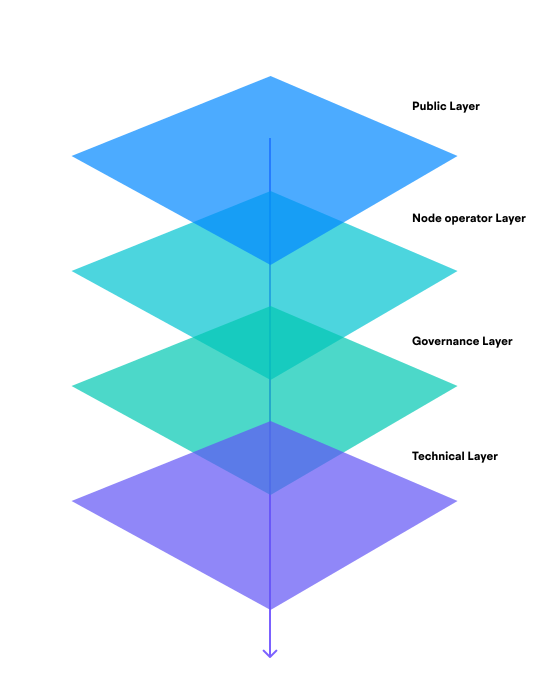
One ecosystem, different levels of control.
Governance, grounded in real rules
For governance, I spoke with the CTO to clarify what "warning", "slashing" (a penalty), or "suspension" should mean, and what criteria should trigger each state. This ensured the interface could reflect real rules, not guesswork.
Visuals that scale
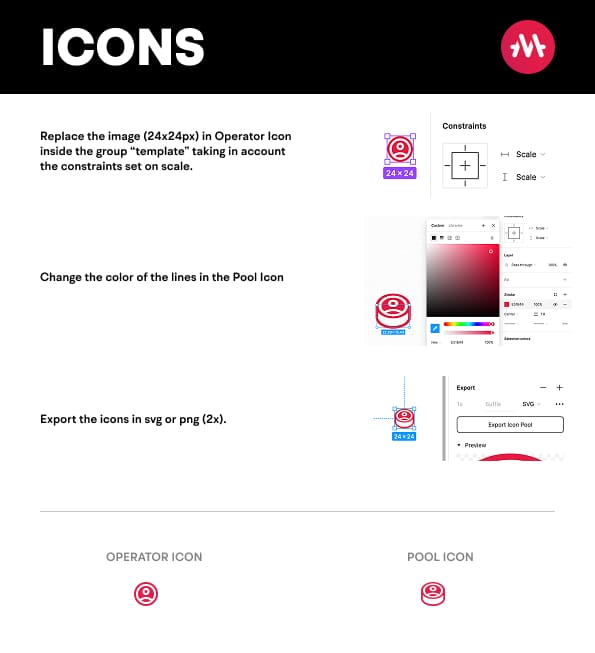
The first request was to produce pool icons manually. With growth that approach would not scale and would centralize responsibility. I reframed the discussion around long-term ownership so autonomy could be distributed.
Templates and incentives
Templates and constraints let node operators upload and manage their own pool visuals in a consistent way. To align incentives, pools that followed the standards could appear higher in the public list, giving operators a clear benefit for doing the work properly. Templates plus constraints reduced noise, improved trust, and made visual identity management scalable.

Outcome
The final system improved clarity and trust across the staking experience. Delegators could compare pools with more reliable signals, node operators gained a focused control center, and governance improved transparency and early detection of issues.
The visual layer turned an unscalable manual process into a structured pipeline. This reduced dependency on a single designer, supported ecosystem growth, and protected consistency as the number of pools increased.